
Circa 1980, Chennai, India. I’m a teenager…
“Divine!” That’s the deep emotion evoked by that sip of South Indian filter coffee (“kaapi” in Tamil) as I take in the fresh morning brew, eyes closed in submission to the Universe. A deep reverence is evoked, something I don’t fully comprehend but rejoice to his day, ushering in the start of yet another beautiful day.
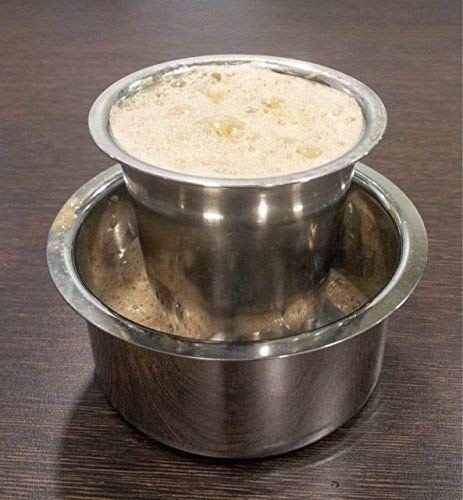
Hot South Indian filter coffee (kaapi) with milk and sugar in a stainless steel tumbler and “dabra” (small metal tumbler or cup) is a morning tradition in Madras, India. There’s a certain level of spirituality that filter kaapi awakens each morning in its devout consumers. It’s the first ritual of the day that helps bring focus and calmness at the beginning of whatever the day has in store.
At my parent’s home where I grew up, filter kaapi kicked off the day.
My mother is the first to wake up and prepare the first cups of this delicious South Indian kaapi. Or, more affectionately, “filter kaapi”! Now that’s important to know because it’s not just coffee.
The journey of a cup of filter kaapi from farm-to-tumbler is quite interesting. In fact, it’s necessary to understand the kaapi story in order to begin to comprehend the reverence that a cup filter kaapi earns with the connoisseurs of South Indian kaapi.
Coffee beans in South India come primarily from the coffee plantations in the Nilgiris or Coorg. Mother buys the beans from the neighborhood grocer, the place where they always arrive, fresh and fragrant. My brother or I hop on our bicycle and pedal those coffee beans to the local coffee grinding place.
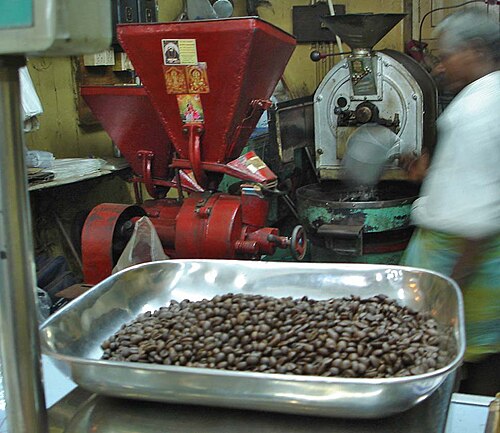
“Hole-in-the-wall” feels like the perfect description of this place. There’s always a line of people waiting to get coffee beans roasted and ground. The coffee grinding machine is a noise monster flaunting the power of automation from the industrial revolution. It’s so loud that people usually give up small talk while waiting. When it’s my turn, I hand over the coffee beans to the operator.
I communicate my desired level of grind to the operator through sign language, which is the only human signal that supersedes the noise and quite effectively so. The operator always understood each customer’s needs through this silent coffee-grind language adding it to the 1,700+ Indian languages and local dialects. The operator, with a sense of deep duty and a joy for this daily grind, commences the bean transformation process. After several minutes of demonstration of the range of pitches that the monster grinder is capable of, the coffee beans come out, well roasted and ground. It smells awesome! I take this back to my mother to do her magic.
The coffee-making process at home begins the previous night. It’s the last activity my mother performs in the kitchen to invite a new day. She carefully adds several spoons of coffee powder to a South Indian coffee filter. Using dry hands, she gently packs the coffee powder with the back of her fingers. Then she adds boiling water to the coffee filter and puts the lid on. The drip process begins and goes on for eight hours through the night. Drop by drop.
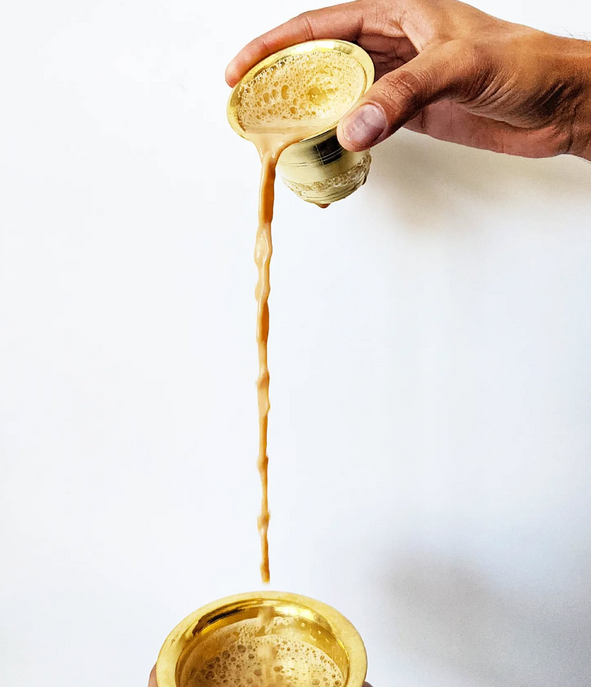
Up early in the morning, mother boils fresh milk. She then carefully adds the fresh coffee decoction to the coffee. Sugar is added for taste. She then mixes the coffee in a very dramatic way, typical of South India, pouring it from a tumbler in one hand into another tumbler in the other hand with both tumblers held two to three feet apart. This is done several times to whip up a nice froth that sits atop the coffee in the stainless steel tumblers. My mother is that morning kaapi juggler, emblematic of the various roles and responsibilities she juggles to run the home and family.
Filter kaapi is ready!
The first sounds of All India Radio in the form of traditional music or chants sets the stage for the next scene of coffee consumption. The place is our living room. Dad, mom, my brother, sister and I each hold our coffee tumbler brimming with kaapi. No words are exchanged. Each of us is immersed in the aroma of fresh kaapi. The first sip awakens the taste buds. Life restarts with the taste of coffee. Kaapi awakens my olfactory senses and flows over to entertain all the other senses that make me fully aware!
Circa now, California….
Many years have gone by since childhood. My parents grew old. I graduated and left home to live and work in the USA.
Thankfully, I brought along the filter kaapi tradition.
I make that first cup of coffee these days. A practice I started 20+ years ago. I adapted my mother’s kaapi recipe. My kaapi paraphernalia in the US consists of a simple coffee grinder and espresso coffee maker of the Target variety and fresh Colombian House Blend coffee beans from Costco. But the ritual and the spirit of the coffee I make is still deeply rooted in the traditions I grew up with. I have perfected the kaapi recipe after hundreds of experiments. Making kaapi in the morning is my zen moment. Along with making my bed, I know the rest of the day is going to be just fine.
Coffee cup in hand, I offer my parents their favorite morning beverage. No words are exchanged. The reverence of coffee mornings from yesteryear engulfs the atmosphere. It’s all calm and quiet. In the silence of this deep coffee reverence, I close my eyes and thank my parents for what they have given me through their countless sacrifices, love and affection.
I feel them acknowledging my gratitude in silence. I sense them smile and embrace me. As I get into a meditative state, I visualize my mother bringing me a tumbler of coffee to the verandah where I’m studying at 6 AM in the morning. She is supporting and encouraging me. I visualize my father lying on the bed while I gently massage his hands. He says that human touch is very important in life. He’s teaching me priorities. I’m engulfed in their love and care for me.
I open my eyes. The coffee is still there. Untouched, it seems. That’s because I am in the prayer room alone. The photos of my parents preside over the prayer room. They attained God’s feet many years ago – my father 35 years ago, my mother 6 years ago.
Our daily connection and conversations over our daily filter kaapi continues. To me, my parents are still alive and guiding me. I owe so much to them in gratitude. I am blessed to be able to say this because I know not everyone has had a loving and lasting relationship with their parents. Quite often, I sip my US-version of kaapi, with a tear of joy rolling down my cheeks and a lump of emotion choking me with emotion love.
“Divine!” That’s the emotion evoked by each sip of South Indian filter kaapi, US-version. A deep reverence is evoked, something I fully feel and rejoice daily, ushering in the start of yet another beautiful day, the “prasad” (Grace) of the Divine.
A new beautiful day that can even line up the stars, even just for a minute.

Images courtesy wikipedia.org https://en.wikipedia.org/wiki/Indian_filter_coffee
Discover more from My Journey Of Gratitude
Subscribe to get the latest posts sent to your email.

 My Journey Of Gratitude